
Sunday, March 29, 2015

Everyday Feminism: "3 Radical Reasons to Be Okay with Not Being Okay (And 4 Ways to Manage the Feelings)"

A smiling, brown-skinned woman leans against a wall with fading paint.
1. Sadness Is Not the Opposite of Self-Love
2. Naming Our Emotions Can Offer Access to Personal Power
3. Sometimes Encouragement Is More About (Their) Discomfort Than (Your) Healing
 
1. Use the Word Processing
2. Make Space for Shared Discomfort
3. Have a ‘Sucky Feelings’ Ritual
4. Recognize a Tendency for Toxic Self-Talk
"3 Radical Reasons to Be Okay with Not Being Okay (And 4 Ways to Manage the Feelings)"


I am a huge believer in self-care as a radical act:
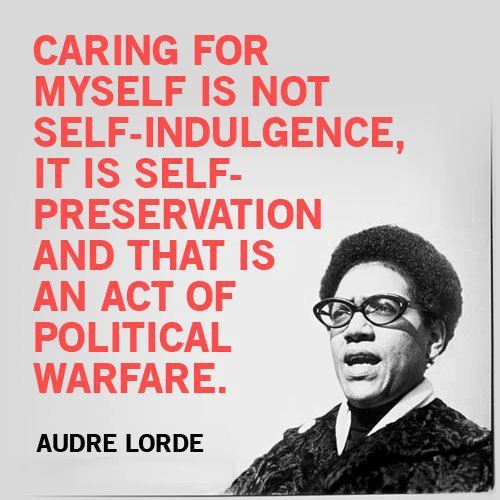
A black and white photograph of Audre Lorde, a black woman with an afro and glasses.
A quote of hers in red text dominates the upper left of the image, transcribed below.

In cahoots,
~Sasha

Saturday, March 28, 2015

KellyMom: "Co-sleeping and Bed-sharing"

Bed-sharing is just one of the ways that a family might co-sleep, but it is frequently practiced by breastfeeding mothers. One of the biggest issues when it comes to bed-sharing is safety. Some sources publicize bed-sharing as an unsafe practice, no matter how it’s done, but there are ways to sleep safely while bed-sharing if you follow guidelines for safe sleep surfaces and safe sleep sharing.
"Co-sleeping and Bed-sharing"

This article is The Go-To Source on cosleeping information. KellyMom is an amazing resource! Check it out!

In cahoots,
~Sasha

"Parents Misled by Cry-It-Out Sleep Training Reports"

Here, we outline parenting media’s top factual and logical failures when reporting on this developmentally risky practice...
1. Research does not support what sleep training reports assume:
  • That sleep training “is fine” for baby —it’s NOT, even when the baby stops protesting.
  • That cry-it-out (extinction of crying) works at home—it does NOT.
  • Age and development level of the child does not matter for sleep training. WRONG.
  • Research shows no harm for babies—NOT: it doesn’t even examine harm to babies!
  • Sleep training research is well done—NOT: poor designs, fidelity, analysis show it is UNRELIABLE.
2. Sleep training reports gloss over the trauma and toxic stress that is done to babies during sleep training, when the brain and body are developing rapidly. Reports overlook how ignoring a baby at night is a form of NEGLECT. 
3. Most parents are not comfortable with cry-it-out (extinction of crying) and they should not be. Babies are meant to be with caregivers all the time. Their wellbeing is undermined otherwise.
"Parents Misled by Cry-It-Out Sleep Training Reports"

I trust families to collaborate and figure out what works best for them. How could I help you with that process?

In cahoots,
~Sasha

"Animals in the Womb: Gorgeous Images."

A fetal elephant in the womb.
These photographs are just stunning. I encourage you to click the link and go check out the whole series.

"Animals in the Womb: Gorgeous Images."

In cahoots,
~Sasha

Friday, March 27, 2015

Refuting "Sleep Training at 8 Weeks: ‘Do You Have the Guts?’"

A terrifying drawing of a white woman, wearing a sleep mask
(alluding to the blindfold of justice) with only one eye covered.
She holds up a scale, with a crying, red-faced baby in the higher cup
and a white, bald, male doctor in the lower cup. The background is a
blue sky-- dark with stars on the baby's side, and light with clouds on the doctor's.
If this was from a less reputably source than NYT, I wouldn't repost it just to refute it, but, in my professional opinion, these pediatricians are awful.


Let's talk about basic development: newborns are learning whether or not the world is a good place: are they safe? are their needs being met? are they loved?

This is a quote from the author of the article, paraphrasing her family pediatrician's words:
She would cry — for hours, possibly — but in about three nights she’d get the picture that nobody was coming to her rescue and would begin to sleep through the night.
A preverbal baby who is crying is trying to communicate:
  • "I am scared."
  • "I am hungry."
  • "My diaper is wet."
  • "Why is it so dark?"
  • "Where is everybody?"
Ignoring attempts to communicate doesn't tell a newborn that they are loved or safe, that their needs will be met. It simply is not developmentally appropriate.

But, Sasha, what alternatives are there? Co-sleeping safely. Checking on a baby who cries-- and getting help from a pro if the crying seems out of the ordinary. Asking friends or family for assistance in the "fourth trimester" so that everyone can still get enough sleep.

Hiring a post-partum doula (like myself) is also an option. It would be an honor to help your family.

In cahoots,
~Sasha

Friday, March 20, 2015

An amazing video of a newborn crawling to mama's breast

I'll be honest: I have no idea how to persuade Blogger to include this amazing video directly. Instead, I'll share with you the link to see the video yourself on FB, courtesy of Lactancia Materna Sur de Córdoba:
Agarre espontáneo al pecho inmediatamente tras el nacimiento
La lactancia materna es la elección del bebé 
Grip spontaneous to the chest and immediately after the birth
Breastfeeding is the choice of the baby
"La lactancia materna es la elección del bebé"

Did your newborn crawl on you this way immediately after birth?

In cahoots,
~Sasha

Wednesday, March 18, 2015

"15 Ways To Help A Friend Who Has A Baby In The NICU"

This photo of a premature white baby was taken from the posterior
end of the incubator, so only a wrinkly baby foot is in focus.
Having a baby in the NICU is tough, whether they are there for a few days or a few months. Being separated from your newborn baby is hard, and being there for them in the hospital so many hours a day can be draining. Parents of babies in the NICU are often exhausted, terrified, hopeful,, running on empty, and falling deeply in love with their new baby. It is an incredibly difficult time, and one you really cannot understand unless you have experienced it yourself. 
As a friend or family member, you have the power to make things a little easier for the new parents, and here’s how...

"15 Ways To Help A Friend Who Has A Baby In The NICU"

These suggestions are actually great advice for supporting any family with a new baby. That advice becomes even more necessary for a family grappling with the special rights of a premature kiddo.

A postpartum doula can be a great support for a family. Do you know a family who needs physical, emotional, logistical, and informational support right now? I'd be honored to help out.

In cahoots,
~Sasha

The #BreakTheSilence Project by Improving Birth

First, a note on photographic representation:
I am keenly aware that most of the babies, parents, and providers shown in the photographs of articles are white. Part of my intention in including the subjects' apparent races in captions is to call attention to this lack of stock photo diversity.

I apologize that one of the first moments in this blog when a bevy of images is available, from which I can choose to represent a person of color rather than a white person, is in a post on trauma. This situation deeply reflects the prejudices of the United States. It also reflects a lack of POC-centered source material on my part, and I am working to correct that moving forward.


Now, for the content itself...
TRIGGER WARNING: written description of obstetric violence against a woman in labor.

Monday, March 16, 2015

"10 Reasons To Hire a Postpartum Doula"

A white baby sleeps, nestled in a white arm tattooed with flowers.
This article is short and sweet, so I'm happy to share it here in its entirety:
10 - So you don’t feel judged while you learn to care for your newborn. A doula offers judgment free support allowing you to develop your “inner-momma” peacefully, smoothly and at your own pace. 
9 - So you can let your guard down and explore your parenting options. Your doula will discuss various parenting philosophies and options with you and support you in every decision YOU make. 
8 - Because early breastfeeding can pose its challenges, having a doula by your side during frustrating or exhausted feedings can be extremely beneficial. 
7 - So you can be nurtured while you nurture your newborn. 
6 - So you can be reminded to eat well and stay hydrated. Simple things like eating and drinking are easily overlooked while focusing on a newborn, however, they are extremely important to your recovery. 
5 - So you can be free of day-to-day household tasks in order to focus on bonding with your baby and your partner. 
4 - For the most up to date information on products relating to babies. Your doula is an expert on all things “baby”, in spite of the ever-changing recommendations and product recalls. 
3 - Doulas are trained to recognize the signs and symptoms of the postpartum baby blues and postpartum depression. Your doula can advise you of what is a “normal” part of your emotional recovery and what you might need some help with. 
2 - So that you can allow yourself “real” sleep, knowing that a trained professional is caring for your baby while you rest and recover. 
And the #1 reason you should hire a postpartum doula is… BECAUSE YOU DESERVE ONE!
"10 Reasons To Hire a Postpartum Doula"

What support did you need more of in "the fourth trimester", immediately after the baby was born? Did you need more physical, emotional, logistical, or informational support?

Are you looking for an extra set of hands and heart and brain for your family? That's what a doula is for! I would be honored to help you out.


In cahoots,
~Sasha

Sunday, March 15, 2015

A "Breastfeeding Latch Trick"

"Breastfeeding Latch Trick from DrMomma.org"
A white breast is shown, with the nipple being pinned upward by a finger.
1) Pinch the areola right next to your nipple so the nipple can be moved (it may take a second for the nipple to evert if it was otherwise flat). You can use your thumb and first finger, or 2 fingers - whichever is easier for that side and the shape of your breasts. If you have 'puffy' breasts, you can also position the rest of your hand under your breast to lift it up slightly and away from your chest.

2) Turn the nipple up so it is pointing at your face. Do not be shocked if some milk exits. This is normal as you are putting very slight pressure on the milk ducts. There is no need to wipe off the milk as the scent will only help to encourage baby to nurse.

3) Position baby's mouth at the bottom of your upturned nipple, so baby's mouth is open over your nipple/finger and onto the above areola.

4) When you let go, the nipple will land deep into baby's mouth - where it is meant to be for comfortable latch and sucking.
This article includes a few videos, demonstrating this maneuver for folks who want to see it in action.

"Breastfeeding Latch Trick"

I'm not a lactation consultant, but I am happy to help trouble-shoot any part of pregnancy, birth, and parenting with you as needed, and help you find resources who know more than me if I'm stumped!

In cahoots,
~Sasha

Friday, March 13, 2015

"Prisons Are Illegally Shackling Pregnant Women While In Labor"

This article is being written about practices in the state of New York, but shackling in labor is a problem nationwide.
The American Medical Association considers the use of shackling during labor both "medically hazardous" and out of line with the "ethics of the medical profession." According to the Women in Prison Project, shackling "heightens the risk of blood clots, limits the mobility needed for a safe pregnancy and delivery, and increases the risk of falling, which can cause serious injury and even death to the fetus." The report also states that shackles can get in the way of administering medical care in emergencies.
"Prisons Are Illegally Shackling Pregnant Women While In Labor"

If you're looking for a local-to-Boston resource that's engaging in this kind of work, check out The Prison Birth Project!!!

In cahoots,
~Sasha

Monday, March 9, 2015

"Exercise Balls Reduce Labor Time and Cesarean Sections"

A white woman with a pregnant belly and relaxed face sits on an exercise ball.
There is a bed in front of her with a big pillow on it, perhaps in a birth center.
The present nurse-led randomized, controlled trial conducted at Banner Good Samaritan Medical Center, a Phoenix hospital part of nonprofit Banner Health, examined the differences between women who used a peanut ball during labor and women who did not. 
The study found that the use of exercise balls during labor can help women who use an epidural, and who are subsequently are usually limited in the number and capacity to try different position changes, offers multiple benefits including decreased labor time, increased circulation, fetal descent, and improved quality of contractions. Ultimately, using a peanut ball resulted in decreased length of labor and increased rate of vaginal birth.

I would love to see this research repeated on a larger scale. I suspect the magnitude of their claims would be reduced a bit with increased data-- halving cesarean rates with a single intervention seems like a small sample size inflating its significance.

Have you tried an exercise ball in labor? How was it for you?
Does your intended birth place have birth balls available?

In cahoots,
~Sasha

Sunday, March 8, 2015

"The Anthropology of sharing a bed with your baby."

"Baby sleep research at the parent infant sleep lab at Durham University."
A white baby, a few months old, mouths a fist while lying down and ogling the camera.
Two blue straps circle their torso, with attached wires trailing offscreen.
Professor Ball explains that many parents do find they will be "accidently" bed sharing with their breast fed baby because it's easier to care for the baby in bed during the intensive night feeding phrase. Parents are not however admitting it publicly. "Parents are frightened to talk to health professionals in some instances and this is one of the things that shuts down he transmission of information on how to do it safely." 
Many of us will admit they slept with the baby in the bed at least once and I am hoping all of us know what makes it safe. 
  • No drugs, alcohol or cigarettes to be consumed (or have been consumed) by anyone in the bed.
  • Do not swaddle the baby, it must be free to move so it doesn't get stuck anywhere in the bed.
  • The bed must be a proper firm mattress, not a couch or a folding bed.
  • If your baby was small at birth or born early (before 37 weeks) bed sharing is not recommended.
"The Anthropology of sharing a bed with your baby."

What professional recommendations have you received on baby sleep? Have your providers been supportive of your choices?

In cahoots,
~Sasha

NPR: "Doctors Urge Patience, And Longer Labor, To Reduce C-Sections"

A surgical spotlight falls artfully on a white newborn,
apparently being lifted out of their mother during a cesarean
birth by two providers in blue scrubs. Mama's body is obscured.
The new guidelines on reducing cesarean deliveries are aimed at first-time mothers, according to the American College of Obstetricians and the Society for Maternal-Fetal Medicine, which released the guidelines Wednesday online and in Obstetrics and Gynecology...
Women giving birth for the first time should be allowed to push for at least three hours, the guidelines say. And if epidural anesthesia is used, they can push even longer. Techniques such as forceps are also recommended to help with vaginal delivery. 
Early labor should also be given more time, the doctors say, with the start of active labor redefined to cervical dilation of 6 centimeters, rather than 4.
"Doctors Urge Patience, And Longer Labor, To Reduce C-Sections"

This interview is fascinating, and not just because it includes updated recommendations for labor! It also talks about the process of medical science, and how we learn to do better. This paragraph might actually be my favorite:
You know, before 1955 there was essentially no quantitative data on the length of labor. Then Emanuel Friedman said we should study this. He studied 500 women, and, of those, he said here are the 200 women who have idealized labors. We then managed 4 million a women a year for the next 50 years based on 200 women. It's not that the wrong approach was taken; it's that we started science and then didn't continue to do the science.
The allopathic, biomedical model isn't ever perfect. What's amazing about it is its ability to improve as we gain new information. Midwives have been making recommendations like these for awhile now, and researchers are investigating those claims, and giving better advice to OBs on that basis.

What should researchers be looking into next to make birth healthier and happier and safer for pregnant folks? Have you seen OBs taking these recommendations into account?

In cahoots,
~Sasha

Tuesday, March 3, 2015

"Parenting Advice: Don't Kill Them"

The face of a white toddler in a carseat,
eyes closed (asleep or faking it?), with a stained mouth.
We try to pretend that other times don’t exist. We try to pretend that good parents (especially mothers) enjoy every minute of parenthood. This, I firmly believe, is a misogynistic tool used to oppress women...  
There will be days where you will find yourself amazed that you have made it through the day without actually giving your child away to the nearest stranger, no matter how clear he’s made it that he hates you and wants to destroy your happiness. You deserve an award for this. There isn’t one, but just know that you do deserve it.
"Parenting Advice: Don't Kill Them"

If you ever need advice on this sort of day, let me know.

In cahoots,
~Sasha

Sunday, March 1, 2015

"The awkward playdate question that could save your child's life"

A child is more likely to be accidentally shot and killed by a firearm than die of an allergic reaction to a peanut. And yet, the conversation about guns among friends, neighbors and relatives has yet to become as routine.
"The awkward playdate question that could save your child's life"

Have you ever asked other families if they keep guns in their home, and how they are stored, before a playdate?

In cahoots,
~Sasha